Reading a Detective Mystery on an E-Reader Without Spoiling Yourself
An ebook makes it tempting to search for every name, highlight every strange sentence, and jump back whenever a theory changes. In a detective story, that freedom needs one small boundary: do not let your tools read ahead of you.
You do not need an elaborate system. A few restrained notes can help you follow a case while leaving most of your attention where it belongs: on the story.
Give yourself a reading boundary
Before revisiting evidence, note the last chapter you have finished. Treat that as your investigation's boundary. A passage in a later chapter is not part of your evidence yet, even if a search result makes it easy to reach.
Be particularly careful with whole-book searches. A list of matches may expose a name, phrase, or association in a chapter you have not read. If your reading app cannot limit a search to the portion you have finished, use a bookmark or your own note instead. You can also wait until the end to search: a first reading and a rereading have different pleasures.
Keep a five-line case note
Use the notes or bookmark feature if your chosen reading app provides one. A paper notebook beside the device works equally well. The method does not depend on a particular brand or a new purchase.
For a detail worth saving, keep only five things:
- Location: the chapter and a short phrase that will help you find the passage again.
- Source: who observed, remembered, or recorded the detail.
- Observation: what the passage actually says happened.
- Question: what you still need to establish.
- Status: confirmed, uncertain, or revised.
Do not make the note a second copy of the novel. One or two sentences are normally enough. Chapter headings and a brief anchor phrase also let you discuss a passage without assuming someone else's page reference will match yours.
Save observations before explanations
Imagine a fictional witness says, "The door was closed when I passed the room." A useful note preserves that limited statement. A less useful note turns it into "Nobody could enter the room."
The second sentence adds claims the witness has not established: that the door was locked, that it remained closed, and that the witness knew about every possible movement. Those may eventually be supported. They are not the same as the original observation.
This is a general example, not a clue from Hidden in the Drizzle. The habit is useful across detective fiction: keep the statement separate from your explanation of it. When your theory changes, the observation should not have to change with it.
Make uncertainty visible
A note marked "uncertain" is useful. It prevents a possibility from quietly becoming a fact while you read another fifty pages.
Instead of writing "the time proves the alibi," write a question: "Does this time describe the event or the report?" Instead of treating two matching accounts as independent confirmation, ask whether one account could be repeating the other.
You are not obliged to solve every question immediately. A mystery deliberately distributes information over time. Leaving a question open can be more accurate, and more enjoyable, than forcing an early answer.
Review your notes at natural pauses
Try checking your notes at the end of a reading session rather than interrupting every page. Keep what still matters, mark a revised assumption, and return to the story.
Do not delete every wrong theory. A short record of a mistaken assumption can make the reveal more satisfying. You can see not just which answer was wrong, but why the evidence initially seemed to support it. That is a more interesting discovery than simply counting how many suspects you guessed.
After finishing, whole-book search becomes a different tool. You can revisit a repeated phrase or trace the first appearance of a detail with the solution already known. That second pass is for understanding the construction, not protecting a first-read surprise.
Trying it with Hidden in the Drizzle
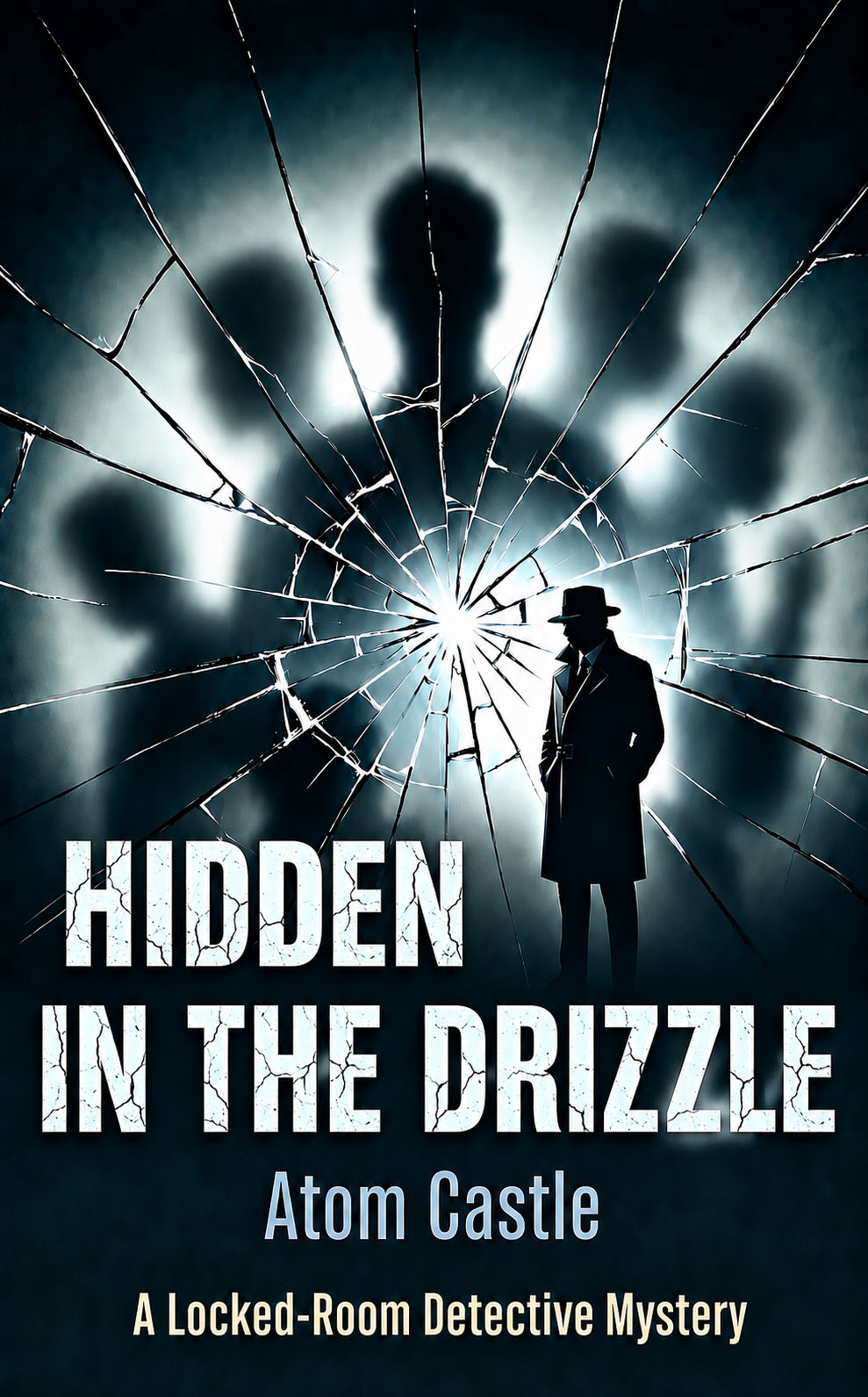
In Hidden in the Drizzle by Atom Castle, a suspect dies in police custody and his corpse disappears from a locked morgue. Detective Arthur Crow follows physical and textual evidence through case files, seven interlocking diary voices, and a rain-drowned city.
It is a dark adult, slow-burn detective novel in the fair-play tradition, with rational rather than supernatural explanations. It is not an interactive puzzle workbook. Notes are optional; readers can simply follow the investigation and enjoy revisiting the evidence afterward.
This guide is published on behalf of Atom Castle as part of the book's own reader resources. It is not an independent review.
Buy the ebook: Hidden in the Drizzle on Books2Read. Choose an available store for your region; prices and availability can vary.
Read the spoiler-free introduction and content notes before deciding whether the book suits your reading preferences.
The point of a mystery notebook is not to turn reading into homework. It is to keep your questions clear while the story does its work.

Comments
Post a Comment