The Mystery Reader's Reference Shelf: 24 Collected Guides
This reference shelf preserves 24 earlier guides from Atom Castle's reader-note archive. They are collected here for ongoing access, not presented as newly written articles or independent reviews. Use the index to jump to a topic; the individual guides retain their original reading advice.
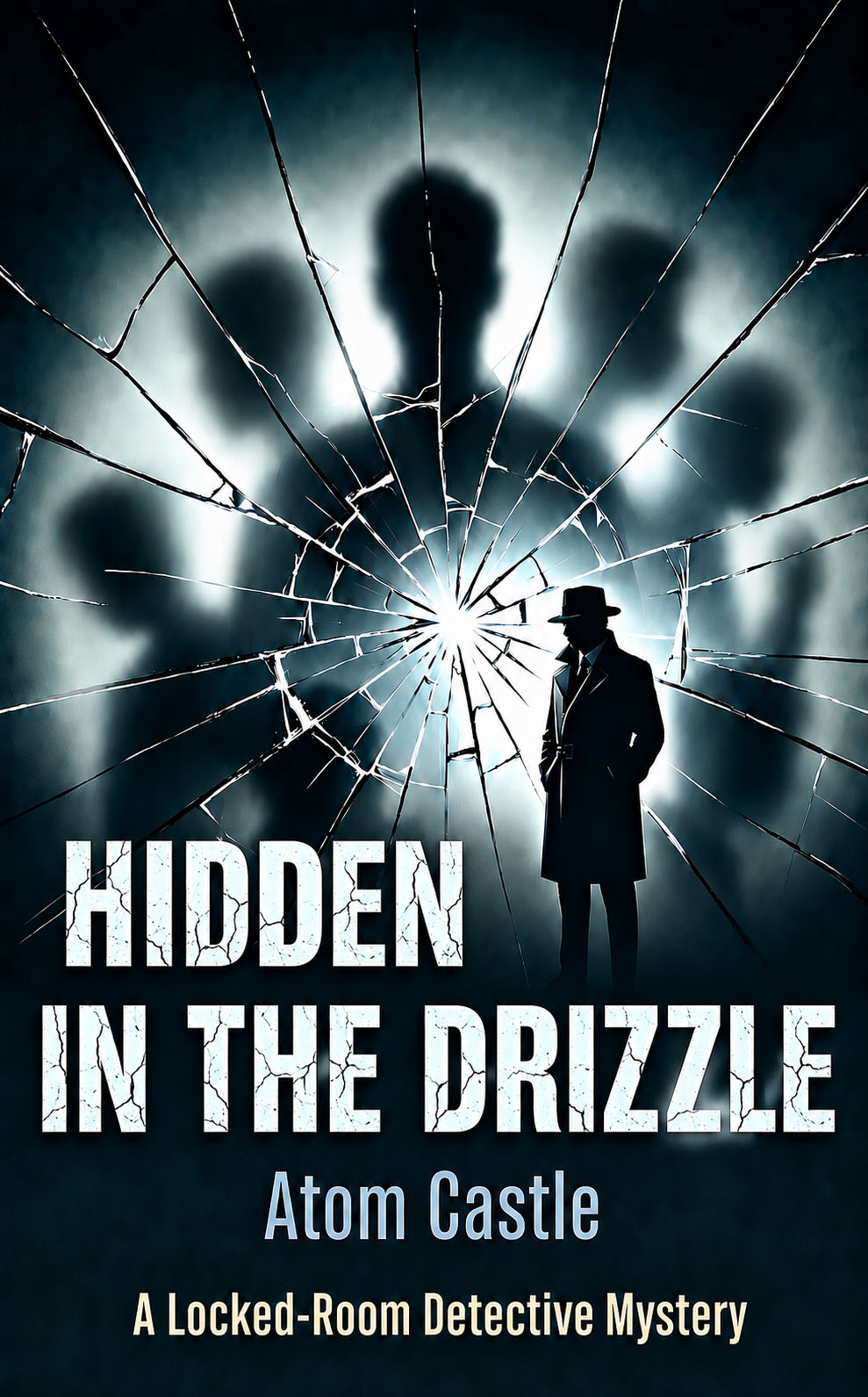
Buy the Hidden in the Drizzle ebook. These are promotional reader resources for the book. Read the book information and adult content notes before deciding whether the novel suits you.
The separately maintained guide to testing an alibi completes the 25-note archive.
Choose a guide
- Why Slow-Burn Pacing Suits a Fair-Play Mystery
- Locked-Room Mystery vs. Closed-Circle Mystery
- A Fair-Play Mystery Reread Checklist
- Five Spoiler-Free Questions for a Locked-Room Mystery Book Club
- How Weather Becomes a Detective Clue
- Why Chain of Custody Matters in Mystery Fiction
- Locked-Room Mystery or Impossible Crime? The Useful Difference
- What Makes a Detective Puzzle Satisfying?
- A Locked-Morgue Mystery Checklist
- Detective Arthur Crow and the Evidence-First Sleuth
- How to Map a Locked-Room Mystery
- Five Mystery Timeline Mistakes Readers Can Avoid
- How to Read a Missing-Corpse Mystery
- What a Rational Impossible-Crime Mystery Promises
- Rational vs. Supernatural Mystery Explanations
- Clue or Red Herring? A Fair-Play Reader's Test
- Observation, Inference, Conclusion: Three Labels for Mystery Readers
- Why an Impossible Crime Does Not Need a Locked Door
- How to Spot a Fair-Play Mystery Before the Final Reveal
- How to Read a Mystery Told Through Diaries and Case Files
- Detective Puzzle Novel vs. Puzzle Book: Which Reading Experience Do You Want?
- How to Compare Witness Statements in a Detective Mystery
- Three Questions Behind a Vanishing-Corpse Mystery
- What Is Textual Forensics in Detective Fiction?
Why Slow-Burn Pacing Suits a Fair-Play Mystery
A fast thriller asks what will happen next. A fair-play mystery often asks what an earlier detail really meant.
That difference gives slow-burn pacing a practical role. The story needs enough space for readers to observe, compare, revise, and return to evidence.
Contradictions need room
A contradiction is rarely useful at the moment it appears.
One witness remembers a door. Another remembers a time. A report uses a phrase that seems routine. The reader may need several later facts before the conflict becomes visible.
Slow pacing lets details remain unresolved without making them disappear.
Documents change the rhythm
Diaries, case files, interviews, and reports ask readers to compare sources.
A document has a creator, purpose, time, and limit. Moving too quickly can turn it into exposition. A slower rhythm lets readers notice repeated language, gaps, and the difference between event time and recorded time.
The detective can show the work
Fair play is more than placing clues on the page. Readers also need a path toward useful questions.
An evidence-first detective can revisit a scene, test a timeline, reject a theory, and explain which assumption failed. Those moments are not delays if they narrow the case.
Atmosphere can carry information
Rain, fog, corridors, and institutional routines create mood, but they can also define visibility, movement, access, and time.
A slow-burn mystery allows atmosphere to behave like part of the physical world. The weather is not only a cinematic filter; it changes what witnesses and investigators can do.
Slow does not mean static
The investigation should still change.
Each interview, document, or reconstruction needs to remove a possibility, deepen a contradiction, or alter the meaning of a clue. The reader may move slowly through the city while the case becomes steadily more precise.
Hidden in the Drizzle is a dark adult, slow-burn locked-room detective mystery by Atom Castle. A corpse disappears from a locked morgue, and Detective Arthur Crow follows physical and textual evidence through seven interlocking diary voices and a rain-drowned city.
The novel favors rational explanation and patient deduction over supernatural answers or nonstop action.
Spoiler-free reading expectations: https://hidden-in-the-drizzle-atom-castle.xudxud2026.chatgpt.site/articles/hidden-in-the-drizzle-spoiler-free-reader-guide
Book page: https://hidden-in-the-drizzle-atom-castle.xudxud2026.chatgpt.site/book More free locked-room and fair-play reading: Ten Free Reader Notes
Buy the ebook: Hidden in the Drizzle by Atom Castle
Locked-Room Mystery vs. Closed-Circle Mystery
A locked-room mystery and a closed-circle mystery both limit possibilities, but they close different things.
The locked room limits physical access. The closed circle limits the suspect pool.
A story can use either form alone or combine them.
The locked-room question
A locked-room mystery asks how an apparently impossible event could occur.
A door is secured, a route is watched, a window is inaccessible, or an object disappears from a controlled space. The reader tests boundaries, travel time, sight lines, keys, custody, and the meaning of words such as “locked” or “sealed.”
The puzzle is usually about method.
The closed-circle question
A closed-circle mystery places the crime inside a limited group.
The suspects may be trapped on an island, snowed into a house, traveling on a train, working inside one institution, or connected by a shared event. Outsiders are unlikely or impossible, so the reader compares motive, opportunity, relationships, and testimony within the group.
The puzzle is often about identity.
Where they overlap
A closed circle can strengthen a locked room.
If only eight people could reach the building and none appears able to enter the room, the reader has two sets of constraints: who belongs in the case and how the event could physically happen.
The solution has to survive both.
How to read each form
For a locked room, ask:
- Which boundary creates the impossibility?
- Who verified it?
- What does it prevent?
- Which movement must a theory explain?
For a closed circle, ask:
- Why is the suspect pool limited?
- Is the limit independently established?
- Which relationships create hidden information?
- Does an outsider theory violate the story's conditions?
A fair solution should not quietly abandon either promise.
Hidden in the Drizzle
Hidden in the Drizzle is a dark adult locked-room detective mystery by Atom Castle. A suspect dies in custody, but his corpse disappears from a locked morgue. Detective Arthur Crow follows physical and textual evidence through a rain-drowned city.
The novel is a slow-burn mystery in the fair-play tradition, with rational rather than supernatural explanations.
Reader case notes: https://hidden-in-the-drizzle-atom-castle.xudxud2026.chatgpt.site/locked-room-mysteries
Book page: https://hidden-in-the-drizzle-atom-castle.xudxud2026.chatgpt.site/book
Buy the ebook: Hidden in the Drizzle by Atom Castle
A Fair-Play Mystery Reread Checklist
The first reading of a detective puzzle asks, “What happened?”
The second asks a different question: “How did the story let me know?”
Revisit the exact problem statement
Write down what seemed impossible before the solution.
Was the room truly sealed? Was the victim certainly identified? Was the time fixed? A reread often reveals that the story stated a narrower fact than the reader remembered.
Mark early physical details
Look again at doors, windows, keys, containers, clothing, weather, distances, and ordinary objects.
The fairest clues often appear mundane because their importance depends on a later connection rather than dramatic emphasis.
Trace every time source
Separate clocks, estimates, scheduled events, messages, sounds, and remembered times.
Then ask which time was independently verified and which was repeated from another person's claim.
Compare wording
Notice repeated phrases, unusual omissions, corrections, and statements that answer a slightly different question.
A character can speak truthfully while encouraging the wrong inference. Fair play does not require every witness to be equally candid.
Record theory changes
Find the moments when the detective or reader should revise a theory.
A useful clue has consequences. It closes one path, opens another, or changes the meaning of earlier evidence.
Test the solution's economy
Does the final explanation account for several clues at once, or does each problem require a separate exception?
Strong detective puzzles usually become simpler after the central misconception is corrected.
Return to the opening chapters
The best rereads reveal that the solution was not merely possible. It was prepared.
Hidden in the Drizzle is a dark adult fair-play mystery by Atom Castle, following Detective Arthur Crow through a locked-morgue case told with physical evidence, diaries, testimony, and case files.
Fair-play mystery guide: https://hidden-in-the-drizzle-atom-castle.xudxud2026.chatgpt.site/articles/what-is-a-fair-play-mystery
Thirty free reader notes: https://telegra.ph/Ten-Free-Reader-Notes-for-Locked-Room-and-Fair-Play-Mystery-Fans-09-04
Book page: https://hidden-in-the-drizzle-atom-castle.xudxud2026.chatgpt.site/book
Buy the ebook: Hidden in the Drizzle by Atom Castle
Five Spoiler-Free Questions for a Locked-Room Mystery Book Club
A locked-room mystery gives a book club more to discuss than the final mechanism. Readers can compare assumptions, evidence, atmosphere, and detective method without forcing everyone to reveal their solution theory at the start.
These five questions work before or after the reveal. If your group has mixed reading progress, agree on the spoiler boundary first.
1. What exactly makes the crime look impossible?
Ask each reader to state the impossible claim in one sentence.
Different answers reveal which boundary feels most important: the lock, the timing, the witnesses, the missing object, or an institutional procedure. The group may discover that it has been solving several versions of the problem.
2. Which statement is observation, and which is inference?
Choose one important witness statement or document.
What did the source directly observe? What conclusion was added? Could the source be sincere and still mistaken?
This question keeps the discussion focused on evidence rather than on deciding too quickly who is lying.
3. Which clue changed your theory?
Ask readers to name the moment when they revised their explanation.
The most interesting answer is not always a dramatic object. It may be a timestamp, a repeated phrase, a routine handoff, or a small spatial detail.
Then ask whether the clue ruled something out or merely created a new possibility.
4. How does the setting affect the logic?
A strong setting changes what characters can do.
Rain may affect movement and visibility. A morgue has procedures and access controls. A city creates routes, delays, and witnesses. A diary creates a gap between event time and recorded time.
Which part of the setting became evidence rather than atmosphere?
5. Did the explanation respect the early facts?
After everyone has finished, return to the opening impossible claim.
Did the ending explain why the case looked impossible? Did earlier details become clearer? Did the solution depend on information introduced too late, or could readers form useful questions from what they had?
A surprising answer and a fair answer are not always the same. Discuss where the book lands.
Try the questions with Hidden in the Drizzle
Hidden in the Drizzle is a dark adult locked-room detective mystery by Atom Castle. A suspect dies in police custody, but his corpse disappears from a locked morgue. Detective Arthur Crow follows physical and textual clues through a rain-drowned city and seven interlocking diary voices.
The novel includes child kidnapping and abuse, animal harm and death, suicide and self-harm, family death, body handling, mental-illness stigma, and strong crime-scene detail.
Download the free four-page discussion guide: https://hidden-in-the-drizzle-atom-castle.xudxud2026.chatgpt.site/hidden-in-the-drizzle-book-club-guide.pdf
Read the spoiler-free book page: https://hidden-in-the-drizzle-atom-castle.xudxud2026.chatgpt.site/book
Buy the ebook: Hidden in the Drizzle by Atom Castle
How Weather Becomes a Detective Clue
Weather in detective fiction can do more than create atmosphere.
Rain, fog, wind, cold, and changing light can alter movement, visibility, sound, surfaces, and the reliability of remembered time.
Weather changes access
A flooded street, muddy path, frozen lock, or blocked bridge can close one route while making another more important.
Treat weather as part of the map. Ask which movements became slower, noisier, more visible, or impossible.
Weather leaves traces
Wet clothing, footprints, water marks, umbrellas, vehicle spray, and disturbed ground can connect a person to a place.
The absence of an expected trace may matter too, but only if the story establishes the conditions clearly enough for that absence to be meaningful.
Fog changes testimony
Poor visibility does not make every witness useless. It changes what the witness could identify.
Someone may reliably observe height, direction, gait, a light, or a voice while being unable to confirm a face. Separate the observation from the later interpretation.
Rain changes sound
Heavy rain can mask footsteps, engines, doors, or conversation. It can also create distinctive sounds of its own.
Ask whether two witnesses standing in different places would have heard the same event under the stated conditions.
Weather can mark time
The start or end of a storm, a power interruption, or a change in visibility can serve as an independent clock.
Compare weather references across diaries, statements, photographs, and official records. A contradiction may reveal that two accounts describe different moments.
A rain-drowned investigation
Hidden in the Drizzle is a fair-play detective mystery by Atom Castle. Its rain and fog shape the investigation around Detective Arthur Crow while the solution remains rational and evidence-led.
Reader guide to rain and fog in detective fiction: https://hidden-in-the-drizzle-atom-castle.xudxud2026.chatgpt.site/articles/rain-fog-city-detective-fiction
Thirty free reader notes: https://telegra.ph/Ten-Free-Reader-Notes-for-Locked-Room-and-Fair-Play-Mystery-Fans-09-04
Book page: https://hidden-in-the-drizzle-atom-castle.xudxud2026.chatgpt.site/book
Buy the ebook: Hidden in the Drizzle by Atom Castle
Why Chain of Custody Matters in Mystery Fiction
Chain of custody sounds like courtroom language, but it is also a powerful reading tool for detective stories.
It asks who controlled a body, object, record, or sample at every stage between discovery and examination.
Possession is a timeline
“The police had it” is not precise enough.
Which officer collected the item? Who transported it? Where was it stored? Who signed it in? Who opened the container? Each handoff creates a point that can confirm identity or introduce uncertainty.
Labels are evidence too
Readers often focus on the physical object and overlook its label, log entry, tag, seal, or photograph.
Those records can establish continuity, but they can also preserve an early mistake. A perfectly maintained chain does not help if the wrong object entered it at the beginning.
Custody is not the same as observation
A locked cabinet may establish control without proving that anyone continuously watched its contents.
Ask whether the story proves physical possession, visual observation, documentary identity, or merely institutional responsibility. Those are related but different claims.
Find the weakest handoff
The important gap is often not a dramatic break-in. It may be an ordinary transfer between people who trusted the same assumption.
Look for unsigned intervals, copied labels, unverified identities, shared keys, or reports written from another person's notes.
Apply the same test to a corpse
A missing-body mystery depends on more than the final locked room. The reader should trace identification, transport, admission, storage, inspection, and discovery.
That produces a sharper question: did the body leave, or did the chain fail to prove which body was present at a particular moment?
Evidence before impossibility
Hidden in the Drizzle is a fair-play locked-room mystery by Atom Castle. A suspect dies in police custody and the corpse later disappears from a locked morgue, drawing Detective Arthur Crow into a case built from physical and textual evidence.
Missing-corpse reading guide: https://hidden-in-the-drizzle-atom-castle.xudxud2026.chatgpt.site/articles/missing-corpse-mystery-reading-guide
Thirty free reader notes: https://telegra.ph/Ten-Free-Reader-Notes-for-Locked-Room-and-Fair-Play-Mystery-Fans-09-04
Book page: https://hidden-in-the-drizzle-atom-castle.xudxud2026.chatgpt.site/book
Buy the ebook: Hidden in the Drizzle by Atom Castle
Locked-Room Mystery or Impossible Crime? The Useful Difference
The terms “locked-room mystery” and “impossible crime” are often used together, but they are not exact synonyms.
A locked-room mystery is built around a controlled space. A crime appears to occur inside a room, building, compartment, or other boundary that no culprit could enter or leave.
An impossible crime is the wider category. The impossible claim may involve space, time, identity, movement, disappearance, or physical evidence. A body can vanish under guard. Footprints can begin or end where no traveler could have reached. A crime can appear to occur during an interval when every suspect is accounted for.
Every locked room belongs to the impossible-crime family. Not every impossible crime needs a locked door.
What the reader tests
For a locked room, start with the boundary:
- Who checked the door, window, or route?
- Was the space watched continuously?
- What did the lock prevent?
- Which movement would a proposed explanation require?
For a wider impossible crime, start with the impossible statement:
- Which facts make the event look impossible?
- Are those facts independent observations?
- Does the time refer to the event or its discovery?
- Is identity supported by direct evidence or by a record?
The difference helps readers avoid hunting for a hidden passage when the real problem may be chronology, classification, or testimony.
Why the distinction matters
Genre labels work best when they describe the reading experience.
A reader choosing a locked-room mystery may expect close attention to space, access, and a rational mechanism. A reader choosing an impossible crime may also enjoy vanishing objects, impossible timing, or contradictory records.
Both forms reward the same discipline: separate observation from inference and test every theory against the established constraints.
Hidden in the Drizzle combines both. A suspect dies in police custody, but his corpse later disappears from a locked morgue. The locked space creates one question; the missing body creates a second timeline. Detective Arthur Crow follows physical and textual evidence through a rain-drowned city.
The novel is a dark adult, slow-burn mystery in the fair-play tradition, written by Atom Castle.
Read the spoiler-free book page: https://hidden-in-the-drizzle-atom-castle.xudxud2026.chatgpt.site/book
Read the full comparison guide: https://hidden-in-the-drizzle-atom-castle.xudxud2026.chatgpt.site/articles/impossible-crime-vs-locked-room-mystery
Buy the ebook: Hidden in the Drizzle by Atom Castle
What Makes a Detective Puzzle Satisfying?
A detective puzzle does not need the most complicated mechanism.
It needs a clear question, evidence with consequences, room for competing theories, and an explanation that changes the meaning of what the reader already saw.
The question is precise
“Something strange happened” creates mystery but not a puzzle.
“How could a body disappear from a controlled room?” gives the reader a problem that can be tested. Identity, method, motive, and timing can each organize a different kind of detective puzzle.
Clues reduce possibilities
A clue should rule something in or out.
It may narrow a time window, challenge a route, connect two documents, or expose the limit of a witness's statement. The clue does not have to announce its importance, but it should matter to the final reasoning.
Wrong theories remain plausible
If only one suspect or explanation ever fits, the case has an answer but little puzzle.
A satisfying mystery lets several theories survive for a while. Each should explain some evidence and fail against something else. Readers then revise instead of merely waiting.
The detective shows the bridge
The reveal should connect observations to conclusion.
Naming the culprit is not enough. The detective explains why the timeline, room, testimony, and records support one account, and why the impossible claim felt persuasive.
The ending rewards rereading
The best test comes after the solution.
Do earlier details become sharper? Does a repeated phrase, routine handoff, or spatial fact gain a clear purpose? Can the reader identify which assumption caused the wrong theory?
A satisfying puzzle produces surprise and recognition together.
A continuous detective puzzle
Hidden in the Drizzle is a continuous novel, not an interactive puzzle book. A suspect dies in police custody, but his corpse disappears from a locked morgue. Detective Arthur Crow follows physical and textual evidence through a rain-drowned city.
Atom Castle wrote the book as a dark adult, slow-burn mystery in the fair-play tradition, with rational rather than supernatural explanations.
What “detective puzzle mystery” means: https://hidden-in-the-drizzle-atom-castle.xudxud2026.chatgpt.site/articles/what-is-a-detective-puzzle-mystery
Book page and content notes: https://hidden-in-the-drizzle-atom-castle.xudxud2026.chatgpt.site/book
Buy the ebook: Hidden in the Drizzle by Atom Castle
A Locked-Morgue Mystery Checklist
A morgue creates a strong impossible-crime setting because it combines physical boundaries with institutional procedure.
A locked door is only one part of the puzzle. The reader also has to consider identification, custody, storage, records, shifts, and the difference between a room being controlled and every object inside it being continuously observed.
1. Define the controlled space
Which doors, windows, corridors, service routes, storage areas, and observation points belong to the claim?
“Locked morgue” may describe a building, a room, a cabinet, or a period when access was restricted. Each boundary prevents different actions.
2. Mark the custody chain
Who handled the body or record at each stage?
Write the sequence of custody without assuming that a signed handoff proves every earlier detail. A signature may establish responsibility from one moment forward.
3. Separate presence from paperwork
A label, inventory, or transfer record is evidence, but ask whether it reflects a direct observation or carries forward information from another source.
Repeated documentation can still depend on one original identification.
4. Build the disappearance window
Find the last direct confirmation of presence and the first direct confirmation of absence.
Then test every proposed movement against access, travel time, visibility, and the people working during that interval.
5. Check ordinary physical requirements
A body has size and weight. It must pass through space, be carried or moved, and remain somewhere afterward.
A theory that cannot explain those requirements is not complete, no matter how clever the lock trick appears.
6. Explain the false certainty
Why did investigators believe the room made disappearance impossible?
The solution should account for the procedure, language, or observation that hardened into certainty. It should not merely reveal a secret exit and ignore the records.
Use the checklist
Hidden in the Drizzle begins with a suspect dying in custody before his corpse vanishes from a locked morgue. Detective Arthur Crow tests physical and textual evidence rather than accepting a supernatural answer.
Atom Castle's novel is a dark adult, slow-burn mystery in the fair-play tradition.
Download the free locked-morgue worksheet: https://hidden-in-the-drizzle-atom-castle.xudxud2026.chatgpt.site/locked-morgue-case-file.pdf
Spoiler-free book page: https://hidden-in-the-drizzle-atom-castle.xudxud2026.chatgpt.site/book
Buy the ebook: Hidden in the Drizzle by Atom Castle
Detective Arthur Crow and the Evidence-First Sleuth
Some fictional detectives dominate a case through speed, confrontation, or instinct. Detective Arthur Crow works differently.
Crow is a private investigator and police consultant in Hidden in the Drizzle, a locked-room mystery by Atom Castle. He is forty-three, restrained, patient, and dryly ironic. His dark gray coat, long black umbrella, and rain-soaked city give him a noir silhouette, but his method is built around evidence rather than performance.
He reconstructs before he declares
Crow's first strength is chronology. He asks which events are directly confirmed, which times belong to a report rather than an action, and where a witness has compressed several moments into one conclusion.
A timeline is not a decorative case-board. It is a constraint. If a theory requires a person to move farther than the available interval allows, the theory must change.
He treats space as evidence
A locked room is a physical claim. Crow tests who controlled the room, what each observer could see, and what the word “locked” actually establishes.
This is especially important when a corpse disappears from a locked morgue. The room, corridor, access procedure, and handoffs all become parts of the same question.
He reads documents as objects
Hidden in the Drizzle uses seven interlocking diary voices and case material. Crow compares wording, dates, omissions, and textual habits with the physical investigation.
A diary may be sincere but written later. A case file may be official but carry forward an earlier assumption. The detective does not decide that every record is false; he identifies what each record can prove.
Why this detective type appeals to puzzle readers
An evidence-first sleuth gives readers room to participate. The decisive action is often a better question rather than a chase.
Readers can build their own timelines, preserve contradictions, and test explanations against the same boundaries the detective examines. Even a wrong theory remains useful because the reveal shows which assumption failed.
Crow's method suits readers who enjoy Sherlock Holmes-style observation, fair-play tradition, impossible crimes, and procedural detail. The book is not a Holmes continuation or imitation; the connection is the pleasure of reasoning from visible facts.
Meet Arthur Crow without plot spoilers: https://hidden-in-the-drizzle-atom-castle.xudxud2026.chatgpt.site/articles/detective-arthur-crow-reading-guide
Book details, content notes, and verified retailer links: https://hidden-in-the-drizzle-atom-castle.xudxud2026.chatgpt.site/book
Buy the ebook: Hidden in the Drizzle by Atom Castle
How to Map a Locked-Room Mystery
A locked-room mystery becomes easier to reason about when the setting is treated as a system rather than a picture.
The useful question is not only “Who entered the room?” It is “What crossed each boundary, when, and under whose observation?”
Draw the outer boundary first
Start with the largest controlled area: a building, floor, corridor, courtyard, or vehicle.
Mark every known entrance, exit, window, service route, and shared wall. Do not assume that the named door is the only meaningful boundary simply because the story emphasizes it.
Add observation points
Place witnesses, cameras, guards, lights, and sight lines on the map.
A door can be physically open yet effectively controlled if someone watches it continuously. The reverse is also true: a locked door may prove little if nobody can establish when it was locked or who possessed the key.
Separate people from objects
Track four categories independently:
- people;
- keys and access tools;
- documents and messages;
- the object or body at the center of the puzzle.
A person may never cross a boundary while an object does. A message can also create a false impression of presence without moving anyone.
Put time onto the map
Create one version for each important interval rather than one permanent diagram.
Who occupied the corridor before discovery? When did the weather change? When was a window checked? A spatial fact can change meaning when its time is corrected.
Test the map against the final claim
A fair solution should explain every necessary crossing or show why the reader misunderstood the boundary.
If the answer depends on a route never established, a key that appears late, or an observation that could not have occurred, the map exposes the weakness.
A locked morgue case
Hidden in the Drizzle is a dark adult fair-play mystery by Atom Castle. After a corpse vanishes from a locked morgue, Detective Arthur Crow tests access, chronology, testimony, and records instead of accepting the room's apparent impossibility.
Locked-room solving guide: https://hidden-in-the-drizzle-atom-castle.xudxud2026.chatgpt.site/articles/how-to-solve-a-locked-room-mystery
Thirty free reader notes: https://telegra.ph/Ten-Free-Reader-Notes-for-Locked-Room-and-Fair-Play-Mystery-Fans-09-04
Book page: https://hidden-in-the-drizzle-atom-castle.xudxud2026.chatgpt.site/book
Buy the ebook: Hidden in the Drizzle by Atom Castle
Five Mystery Timeline Mistakes Readers Can Avoid
A timeline is one of the best tools for solving a detective puzzle, but only if it records the right kind of information.
These five mistakes make a case look clearer while quietly preserving the wrong assumptions.
1. Treating discovery time as crime time
The body, missing object, or unlocked door is discovered at a particular moment. That timestamp closes an interval; it does not necessarily identify when the event occurred.
Keep discovery and event time separate.
2. Copying conclusions into the fact column
“The room was sealed” may be a conclusion.
The fact may be narrower: a witness tried one handle at 10:05. Record the observation first, then note the inference beside it.
3. Using one clock as if it were universal
Witnesses, phones, wall clocks, reports, and security systems may not share the same time source.
The story may not rely on a broken clock, but small differences matter when an alibi or route depends on minutes.
4. Recording every event
A giant chronology hides the interval that matters.
Start with two anchors: the last confirmed normal state and the first confirmed abnormal state. Add only events that limit movement, access, identity, or knowledge.
5. Refusing to revise
A timeline is a theory-testing tool, not a permanent record.
When a timestamp is reinterpreted or an observation becomes less reliable, change the interval. A useful timeline becomes smaller and more precise as evidence improves.
A compact format
Use three columns:
- time;
- direct observation;
- what the observation limits.
Put theories in a separate section. This prevents an early guess from hardening into the chronology.
Try it on a locked morgue
Hidden in the Drizzle begins with a suspect dying in custody before his corpse disappears from a locked morgue. Detective Arthur Crow follows physical and textual evidence through a rain-drowned city.
Atom Castle's novel is a dark adult, slow-burn mystery in the fair-play tradition.
Free printable case file: https://hidden-in-the-drizzle-atom-castle.xudxud2026.chatgpt.site/locked-morgue-case-file.pdf
Spoiler-free book page: https://hidden-in-the-drizzle-atom-castle.xudxud2026.chatgpt.site/book
Buy the ebook: Hidden in the Drizzle by Atom Castle
How to Read a Missing-Corpse Mystery
A missing corpse changes the detective's job. The crime is no longer anchored by the object that should provide identity, location, condition, and time.
The reader now has two investigations: what happened to the victim, and what happened to the body afterward.
Find the two anchor observations
Start with the last direct observation that proves the body was present. Then find the first direct observation that proves it was absent.
Do not substitute paperwork for sight unless the story establishes that the record came from a direct check. A transfer form may prove that someone processed a handoff. It does not automatically prove every description attached to the handoff.
The interval between those anchors is the disappearance window.
Give the body physical properties
A body has weight, volume, temperature, and a route through space. Moving it requires time and access. Concealing it changes what people can carry, clean, record, or observe.
Ask:
- Which exits were available?
- Who controlled the location?
- What could contain or conceal the body?
- Which movement would leave a trace?
- Who could perform the movement during the available interval?
The missing object may be absent, but its consequences remain.
Reopen identity carefully
A missing-corpse story may challenge identity, but do not assume a substitution immediately.
List what supports the victim's identity: a direct facial observation, a document, clothing, context, medical information, or another person's statement. Then separate independent confirmation from repeated labels.
The question is not “Was everyone fooled?” It is “What does each source actually establish?”
Connect the disappearance to the first crime
A complete theory should explain more than the removal.
Why did the body need to disappear? Which part of the original death becomes harder or easier to prove? Does the disappearance protect a person, alter a timeline, hide an object, or force investigators to accept a particular account?
The strongest solutions make the two mysteries depend on one another.
Try the method
Hidden in the Drizzle is a dark adult locked-room detective mystery by Atom Castle. A suspect dies in police custody, but his corpse disappears from a locked morgue. Detective Arthur Crow reconstructs chronology, access, diaries, and case material through a rain-drowned city.
The novel is a slow-burn mystery in the fair-play tradition, with rational rather than supernatural explanations.
Read the spoiler-free missing-corpse guide: https://hidden-in-the-drizzle-atom-castle.xudxud2026.chatgpt.site/articles/missing-corpse-mystery-reading-guide
Book page and content notes: https://hidden-in-the-drizzle-atom-castle.xudxud2026.chatgpt.site/book
Buy the ebook: Hidden in the Drizzle by Atom Castle
What a Rational Impossible-Crime Mystery Promises
An impossible crime creates a temporary conflict between evidence and reality.
The locked room, vanishing object, impossible timeline, or unbroken footprints appear to rule out every ordinary explanation. A rational mystery promises that the conflict will be resolved without changing the laws of the story at the last moment.
The impossible claim will become precise
“Nothing could explain this” is not a usable puzzle.
A rational mystery gradually shows which conditions create the impossibility: access, time, identity, observation, custody, or movement. Readers can then test those conditions instead of guessing unlimited tricks.
Physical facts will have consequences
Objects have weight and volume. Routes take time. Weather changes traces. Rooms limit sight and movement. Records are created by people at particular moments.
The solution should respect those consequences. It may reveal that a condition was misunderstood, but it should not make the established world irrelevant.
Testimony will have limits
A witness can be truthful without being complete.
Readers should be able to ask where the witness stood, what they actually observed, and which part of the account is interpretation. The same applies to diaries, reports, and official labels.
The goal is not automatic distrust. It is precision.
The reveal will connect evidence
A rational solution does more than name a culprit or expose a device.
It explains why the impossible claim felt convincing. It connects the boundary, timeline, witnesses, and records. Earlier details become clearer on a reread.
That does not guarantee every reader will solve the case. It promises that reasoning matters.
Hidden in the Drizzle
Hidden in the Drizzle is a dark adult locked-room detective mystery by Atom Castle.
A suspect dies in police custody, but his corpse disappears from a locked morgue. Detective Arthur Crow follows physical and textual evidence through a rain-drowned city and seven interlocking diary voices.
The book uses rational rather than supernatural explanations and follows the fair-play tradition. It is a slow-burn investigation, not an interactive puzzle book.
Spoiler-free answer about the supernatural question: https://hidden-in-the-drizzle-atom-castle.xudxud2026.chatgpt.site/articles/is-hidden-in-the-drizzle-supernatural
Book details, content notes, and verified links: https://hidden-in-the-drizzle-atom-castle.xudxud2026.chatgpt.site/book More free locked-room and fair-play reading: Ten Free Reader Notes
Buy the ebook: Hidden in the Drizzle by Atom Castle
Rational vs. Supernatural Mystery Explanations
A mystery can use rain, shadows, folklore, fear, and apparently impossible events without becoming supernatural fiction.
The difference lies in the explanation the story ultimately asks the reader to accept.
Rational mystery
A rational mystery treats the impossible appearance as a problem of evidence.
The solution follows physical conditions, chronology, identity, testimony, documents, and human action. Characters may believe in a supernatural cause, but the final account does not require one.
The reader can test the explanation against the established world.
Supernatural mystery
A supernatural mystery allows forces beyond ordinary physical explanation to be real within the story.
A ghost, curse, prophecy, psychic ability, or other extraordinary cause may be part of the final truth rather than a mistaken interpretation.
This form can still contain clues and deduction. Its rules are simply wider.
Why readers need the distinction
Some readers enjoy eerie atmosphere but want a rational solution. Others want the supernatural promise fulfilled rather than explained away.
A spoiler-free description should make the contract clear without revealing the mechanism.
Words such as “impossible crime,” “locked-room mystery,” and “rational explanation” signal one experience. “Paranormal mystery,” “occult detective,” or “supernatural suspense” signal another.
Atmosphere is not evidence of genre
Fog does not prove ghosts. A disturbing diary does not prove possession. A city under endless rain can heighten isolation while every event remains physical.
Ask what the story establishes as possible, not only how the scene feels.
Hidden in the Drizzle
Hidden in the Drizzle is not a supernatural mystery. It is a dark adult locked-room detective novel by Atom Castle, using rational rather than supernatural explanations.
A suspect dies in police custody, but his corpse disappears from a locked morgue. Detective Arthur Crow follows physical and textual evidence through seven interlocking diary voices and a rain-drowned city.
Full spoiler-free answer: https://hidden-in-the-drizzle-atom-castle.xudxud2026.chatgpt.site/articles/is-hidden-in-the-drizzle-supernatural
Book page and content notes: https://hidden-in-the-drizzle-atom-castle.xudxud2026.chatgpt.site/book
Buy the ebook: Hidden in the Drizzle by Atom Castle
Clue or Red Herring? A Fair-Play Reader's Test
A clue points toward the solution. A red herring points toward a believable alternative.
The difference is not that one matters and the other is useless. A fair red herring should still reveal something true: a secret, motive, relationship, mistake, or secondary wrongdoing. It misdirects the reader without becoming random decoration.
Ask what the detail changes
A useful detail limits at least one theory.
A muddy footprint may challenge an alibi. A repeated phrase may connect two documents. A missing timestamp may reopen the sequence of events.
If a detail creates suspicion but changes no possible explanation, it may be atmosphere rather than a clue or red herring.
Test the source
Who noticed or reported the detail?
A witness can describe an observation accurately while misinterpreting it. A formal record can preserve an early assumption. A rumor can appear in several places without becoming independent confirmation.
The source determines what the detail can prove.
Look for a second truthful meaning
The best red herrings survive the reveal.
A suspect really was hiding something, but not the murder. A witness really did alter a record, but for a different reason. An object really did move, but not during the crime.
The misleading interpretation falls away while the underlying fact remains.
Check the final explanation
After the reveal, ask:
- Why did this detail attract attention?
- What did it actually establish?
- Which wrong theory did it support?
- How was that theory fairly ruled out?
- Does the detail still have a purpose?
A red herring that vanishes without explanation is noise. A resolved red herring makes the case feel inhabited by real people whose secrets do not all belong to one crime.
Fair play and Hidden in the Drizzle
Hidden in the Drizzle is a dark adult locked-room mystery by Atom Castle. A corpse disappears from a locked morgue, and Detective Arthur Crow compares physical clues, chronology, diaries, and case material through a rain-drowned city.
The novel is in the fair-play tradition and uses rational rather than supernatural explanations.
Read the spoiler-free fairness guide: https://hidden-in-the-drizzle-atom-castle.xudxud2026.chatgpt.site/articles/what-makes-an-impossible-crime-clue-fair
Book page: https://hidden-in-the-drizzle-atom-castle.xudxud2026.chatgpt.site/book
Buy the ebook: Hidden in the Drizzle by Atom Castle
Observation, Inference, Conclusion: Three Labels for Mystery Readers
Mystery readers often write down clues but still feel that the case is slipping away. The problem is not a lack of notes. It is that facts and interpretations are mixed together.
Three labels can clean up the case: observation, inference, and conclusion.
Observation
An observation is what a source directly saw, heard, measured, recorded, or handled.
“The witness saw the door closed at 9:10” is an observation. “The room was sealed all evening” is not, unless someone continuously verified every route and condition.
Observations can still be limited. Rain affects visibility. A witness may identify a coat but not a face. A clock may be wrong. The label does not guarantee accuracy; it identifies the kind of claim.
Inference
An inference connects observations.
“The culprit probably used the main corridor” may follow from the floor plan. “The diary was written after the event” may follow from a phrase the writer could not have known earlier.
An inference is useful because it can be tested. Ask what evidence supports it and what new observation would weaken it.
Conclusion
A conclusion answers the central question.
It may identify a culprit, explain a locked room, establish the route of a missing object, or connect several records into one account. A strong conclusion survives the established constraints and explains why the wrong picture seemed persuasive.
The danger is promoting an inference to a conclusion too early. Once that happens, later clues are forced to fit it.
A simple marking system
Use O, I, and C beside your notes.
When two claims conflict, check whether they belong to the same level. An observation may contradict another observation. More often, one person's inference conflicts with another person's direct account.
Keep the labels until the reveal. You may discover that the story never lied; a character simply treated an inference as if it were a fact.
Hidden in the Drizzle gives readers physical clues, seven interlocking diary voices, and case material. Detective Arthur Crow separates what the record says from what it can prove after a corpse vanishes from a locked morgue.
Atom Castle's novel is a dark adult, slow-burn locked-room mystery with rational rather than supernatural explanations.
Free reader clue worksheet: https://hidden-in-the-drizzle-atom-castle.xudxud2026.chatgpt.site/locked-morgue-case-file.pdf
Book details and content notes: https://hidden-in-the-drizzle-atom-castle.xudxud2026.chatgpt.site/book More free locked-room and fair-play reading: Ten Free Reader Notes
Buy the ebook: Hidden in the Drizzle by Atom Castle
Why an Impossible Crime Does Not Need a Locked Door
The classic locked room is easy to picture: a body inside, a door secured from within, windows that offer no route, and witnesses who make ordinary entry or exit impossible.
But the larger impossible-crime tradition does not depend on architecture. It depends on a contradiction between an event and the conditions that supposedly govern it.
Time can replace the door
A crime may appear impossible because the available interval is too short.
Every suspect seems to be observed elsewhere. A journey takes longer than the gap between two confirmed events. A record places an object in one location moments before it appears in another.
The timeline becomes the sealed room. The reader tests timestamps, travel, observation, and the difference between when an event occurred and when it was discovered.
Identity can replace the door
An impossible claim may depend on who a person or object is believed to be.
A name on a record, familiar clothing, or a routine label can become a substitute for direct observation. The puzzle is not automatically mistaken identity; the reader simply has to ask what evidence supports the identification.
If the identity claim changes, the boundaries of the case change with it.
Absence can replace the door
A missing object creates physical constraints even when no room is sealed.
The object has size, weight, a last confirmed location, and a route it would have to travel. Someone must control, conceal, transfer, or misdescribe it. Absence is not magic; it leaves consequences.
A missing corpse is a powerful version of this problem because the evidence that should anchor the investigation has itself become unstable.
Test the impossible sentence
Write the case in one sentence: “This could not happen because…”
Then separate the sentence into facts and conclusions. Which part was directly observed? Which part came from a record? Which boundary actually rules out an action?
This method works whether the impossible claim involves a room, a clock, footprints, a disappearance, or a chain of custody.
Hidden in the Drizzle combines a locked space with a missing-body problem. A suspect dies in police custody, but his corpse disappears from a locked morgue. Detective Arthur Crow tests physical and textual evidence through a rain-drowned city.
The novel is a dark adult, slow-burn mystery in the fair-play tradition, written by Atom Castle.
Spoiler-free book page: https://hidden-in-the-drizzle-atom-castle.xudxud2026.chatgpt.site/book
Impossible-crime comparison: https://hidden-in-the-drizzle-atom-castle.xudxud2026.chatgpt.site/articles/impossible-crime-vs-locked-room-mystery More free locked-room and fair-play reading: Ten Free Reader Notes
Buy the ebook: Hidden in the Drizzle by Atom Castle
How to Spot a Fair-Play Mystery Before the Final Reveal
A fair-play mystery invites the reader to reason with the detective. That does not mean the solution must be easy, or that every important clue arrives with a spotlight. It means the story gives evidence a real job.
You can usually recognize the form long before the final chapter by watching how it treats observations, contradictions, and explanations.
The detective asks testable questions
A broad question such as “Who seems suspicious?” can create drama, but it does not create a deduction.
Fair-play mysteries move toward questions that evidence can answer:
- Who could reach the room during the available interval?
- Which witness saw the event rather than hearing about it?
- Does the timestamp record the action, the discovery, or the report?
- Which theory explains both the clue and the mistaken conclusion?
These questions reduce possibilities. They give the reader a way to participate without needing information from outside the story.
Clues have consequences
A clue is not simply an unusual object or an ominous sentence. It changes what can be true.
A wet coat may challenge a route. A repeated phrase may connect two documents. A key may establish possession without proving use. A delay in a routine handoff may reopen a timeline.
When a clue matters, later reasoning should depend on it. Decorative strangeness can create atmosphere, but a fair puzzle eventually shows why its important details were worth noticing.
Witnesses can be honest and wrong
A fair-play story does not need every witness to lie. In fact, sincere mistakes often create stronger puzzles.
People describe conclusions as if they were observations. “No one entered” may mean “I did not see anyone use the main door.” “The room was sealed” may mean “the handle did not move when I checked it.” “That was the victim” may depend on clothing, paperwork, or expectation.
The reader can respect the witness while testing the limits of the statement.
Records have sources
A fact repeated in three documents may still come from one original observation.
Police notes quote witnesses. News reports quote police. Later memories absorb the public version. Repetition makes the claim feel stable, but it does not make three independent confirmations.
Fair-play reading traces important facts backward. Who first recorded the detail? What was that person able to know? Why was the record created? When did it enter the timeline?
The solution explains the mistake
A satisfying reveal does more than identify the culprit or describe a mechanism. It explains why intelligent people accepted the wrong picture.
Perhaps a category was mistaken for an observation. Perhaps two accurate times referred to different events. Perhaps a boundary prevented one action but not another. Perhaps a document preserved the truth in language no one examined closely enough.
The strongest solution keeps the early evidence and changes its meaning. On a reread, the story becomes more precise rather than less relevant.
A five-point reader test
Before the final reveal, ask:
- Can I state the central mystery in one sentence?
- Can I separate observations from conclusions?
- Do important clues limit at least one theory?
- Can testimony be checked against time, space, or another source?
- Would my theory explain why the case first appeared impossible?
You do not need to solve the case to enjoy the test. A wrong theory can make the ending more satisfying because you can identify exactly where your assumption failed.
A fair-play locked-morgue mystery
Hidden in the Drizzle is a dark adult detective novel by Atom Castle. A suspect dies in police custody, but his corpse disappears from a locked morgue. Detective Arthur Crow reconstructs physical and textual evidence through a rain-drowned city and seven interlocking diary voices.
The novel is in the fair-play tradition and uses rational rather than supernatural explanations. It is a slow-burn investigation, not an interactive puzzle book or a nonstop action thriller.
Read the spoiler-free book page and content notes: https://hidden-in-the-drizzle-atom-castle.xudxud2026.chatgpt.site/book
Use the free reader clue checklist: https://hidden-in-the-drizzle-atom-castle.xudxud2026.chatgpt.site/articles/how-to-solve-a-locked-room-mystery More free locked-room and fair-play reading: Ten Free Reader Notes
Buy the ebook: Hidden in the Drizzle by Atom Castle
How to Read a Mystery Told Through Diaries and Case Files
A diary, police report, interview, or case file can feel more authoritative than ordinary narration because it looks like evidence.
The useful question is not whether the document is “true.” Ask what kind of truth it can preserve.
Record four things
For every important document, note:
- Who created it?
- When was it created?
- What was it meant to do?
- What could its creator directly know?
These four questions prevent a common mistake: treating the date on a document as the time of the event.
A diary entry may describe yesterday. A report may be filed hours after an interview. A later summary may repeat an early witness's wording. The record can be authentic while remaining indirect.
Separate document time from event time
Document time is when the record was made. Event time is when the described action occurred. Knowledge time is when the writer learned about it.
Those three times may differ.
If a mystery uses several documents, build a timeline with separate columns. A contradiction may disappear because two writers were describing different moments—or become more important because one writer knew something too early.
Compare function, not just content
A diary preserves private attention. A shift log preserves responsibility. An inventory preserves objects. An interview transcript preserves wording.
Two documents can omit different facts because they serve different purposes. An omission is not automatically deception. It becomes evidence when the missing detail conflicts with what the record was supposed to capture.
Follow repeated language back to its source
A claim repeated in several files may still depend on one original observation.
Trace the wording backward. If a police summary quotes a witness and a newspaper later quotes the summary, three texts do not equal three independent confirmations.
This source discipline turns documents into testable evidence instead of exposition.
Documentary mystery in Hidden in the Drizzle
Hidden in the Drizzle combines third-person investigation with seven interlocking diary voices and case material. A suspect dies in custody, but his corpse disappears from a locked morgue. Detective Arthur Crow compares textual and physical evidence rather than accepting a supernatural shortcut.
Atom Castle wrote the novel as a dark adult, slow-burn mystery in the fair-play tradition.
Read the complete spoiler-free epistolary guide: https://hidden-in-the-drizzle-atom-castle.xudxud2026.chatgpt.site/articles/what-is-an-epistolary-mystery
Explore the book and content notes: https://hidden-in-the-drizzle-atom-castle.xudxud2026.chatgpt.site/book
Buy the ebook: Hidden in the Drizzle by Atom Castle
Detective Puzzle Novel vs. Puzzle Book: Which Reading Experience Do You Want?
“Puzzle mystery” can describe two different kinds of book.
One is a continuous detective story whose clues let the reader form a theory. The other contains explicit riddles, codes, grids, choices, or activities that the reader completes.
Both can be satisfying. They ask for different kinds of participation.
The puzzle inside the story
In a detective puzzle novel, the narrative carries the game.
A witness chooses a precise word. A timestamp defines an interval. A locked door limits movement. A diary contains information its writer should not yet know. Readers participate by interpreting context.
You can read straight through without stopping to solve a separate task. The puzzle remains part of character, atmosphere, and plot.
The puzzle beside the story
An interactive puzzle book makes the task visible.
You may solve a cipher, fill a logic grid, choose a route, examine an illustration, or answer a riddle before continuing. The activity has its own rules and often its own immediate solution.
The story provides motivation or context, but the reader's action is distinct from ordinary reading.
Hybrid books
Some books combine both.
A case-file narrative may include detachable evidence, maps, or explicit challenges. A novel may pause for an activity. The useful question is whether the story still works without completing the task.
There is no hierarchy. Readers who enjoy prose, character, and deduction may prefer the novel. Readers who want hands-on challenges may prefer the activity book. Hybrids serve readers who want both.
How Hidden in the Drizzle fits
Hidden in the Drizzle is a continuous detective novel, not an interactive puzzle book.
A suspect dies in police custody, but his corpse disappears from a locked morgue. Detective Arthur Crow reconstructs chronology, physical boundaries, diaries, and case material. Reader participation comes from following contradictions and evidence rather than completing standalone riddles.
The book is a dark adult, slow-burn mystery in the fair-play tradition, written by Atom Castle.
Full terminology guide: https://hidden-in-the-drizzle-atom-castle.xudxud2026.chatgpt.site/articles/what-is-a-detective-puzzle-mystery
Spoiler-free book page: https://hidden-in-the-drizzle-atom-castle.xudxud2026.chatgpt.site/book More free locked-room and fair-play reading: Ten Free Reader Notes
Buy the ebook: Hidden in the Drizzle by Atom Castle
How to Compare Witness Statements in a Detective Mystery
Two witnesses can both be honest and still appear to contradict one another.
They may stand in different places, notice different details, use different clocks, or describe conclusions as if they were observations. Comparing testimony is therefore not a contest to decide who is lying first.
It is a test of source, position, time, and language.
Rewrite each statement as an observation
“The suspect left at ten” may mean:
- the witness saw the suspect cross the doorway;
- the witness heard a door;
- the witness later noticed the suspect was gone;
- another person said the suspect had left.
Those are different observations. Rewrite the statement at the narrowest level the source supports.
Mark the viewing position
Where was the witness?
A corridor may reveal who approached a door but not what happened inside. Rain may hide a face while leaving a coat or umbrella visible. A witness may hear movement without knowing its direction.
Position defines the boundary of testimony.
Separate event time from remembered time
Ask whether the witness checked a clock, inferred the time from routine, or estimated it later.
Two accounts may disagree because one uses a wall clock and another reconstructs the moment from a train, phone call, or shift change.
The story does not need a broken clock. Human timekeeping is already imperfect.
Trace repeated language
If several witnesses use the same unusual phrase, ask whether they spoke independently or learned the phrase from a report, conversation, or news account.
Repeated wording can show shared information rather than shared observation.
Preserve the conflict
Do not erase a contradiction by choosing a favorite witness.
Keep both statements until a physical clue, independent record, or clearer timeline tests them. The contradiction identifies the next useful question.
Detective Arthur Crow's kind of case
In Hidden in the Drizzle, a corpse disappears from a locked morgue. Detective Arthur Crow reconstructs timelines and compares physical and textual evidence through seven interlocking diary voices and case material.
Atom Castle's novel is a dark adult, slow-burn locked-room mystery with rational rather than supernatural explanations.
Reader guide to diaries and case files: https://hidden-in-the-drizzle-atom-castle.xudxud2026.chatgpt.site/articles/what-is-an-epistolary-mystery
Spoiler-free book page: https://hidden-in-the-drizzle-atom-castle.xudxud2026.chatgpt.site/book
Buy the ebook: Hidden in the Drizzle by Atom Castle
Three Questions Behind a Vanishing-Corpse Mystery
When a detective story says a corpse vanished, the sentence contains several claims that should be tested separately.
Was the person correctly identified? Was the body continuously present? Is the disappearance time actually known?
Question one: identity
Who confirmed the dead person's identity, and how?
A face, clothing, paperwork, a witness, or an expected location may feel conclusive while proving different things. A fair-play mystery tells readers which identification method was used, even if its importance is easy to miss.
Question two: movement
What would have to move, and through which boundary?
The problem may involve a whole body, a container, a trolley, a vehicle, or a change in what observers believed they were guarding. Measure the physical claim against doors, routes, weight, noise, weather, and available time.
Question three: timing
When was the body last independently confirmed?
The moment of death, transport, storage, final observation, and reported discovery are not automatically the same timeline. A long unexamined interval can hide inside a confidently stated short one.
Keep the questions separate
A strong theory should answer identity, movement, and timing together.
Solving only one produces an incomplete explanation. A body-swap theory still needs opportunity. A secret-route theory still needs correct identification. A timeline theory still has to account for physical conditions.
Why the puzzle feels impossible
Readers naturally compress the claims into one image: a known corpse, certainly inside, suddenly gone from a sealed place.
The detective's job is to unpack that image into testable statements.
The locked morgue hook
Hidden in the Drizzle is a dark adult impossible-crime novel by Atom Castle. Detective Arthur Crow investigates after a corpse disappears from a locked morgue, using chronology, testimony, case files, and material clues.
Spoiler-free explanation of the hook: https://hidden-in-the-drizzle-atom-castle.xudxud2026.chatgpt.site/articles/locked-morgue-problem-missing-corpse-hook
Thirty free reader notes: https://telegra.ph/Ten-Free-Reader-Notes-for-Locked-Room-and-Fair-Play-Mystery-Fans-09-04
Book page: https://hidden-in-the-drizzle-atom-castle.xudxud2026.chatgpt.site/book
Buy the ebook: Hidden in the Drizzle by Atom Castle
What Is Textual Forensics in Detective Fiction?
Textual forensics means treating writing as evidence.
A diary, report, letter, transcript, or case file is not only a container for information. Its wording, structure, date, omissions, revisions, and relationship to other records can reveal how and when it was created.
Start with the source
Who wrote the document?
The author determines what the text could know, what language would be natural, and which audience it was designed to reach. A private diary, police report, and public statement may describe the same event differently without one being automatically false.
Separate event time and writing time
A dated entry may describe an earlier event. A report may be completed after several interviews. A later summary may copy the wording of an earlier document.
Ask what the date proves: the event, the writer's knowledge, the act of writing, or the filing of the record.
Compare repeated language
An unusual phrase appearing twice may suggest shared authorship, copying, influence, or a common source.
Repetition is not proof by itself. It becomes useful when the phrase is distinctive and the story establishes who had access to it.
Notice omissions in context
A missing detail matters only if the document had a reason to record it.
An inventory that omits an object may be significant. A personal diary that omits routine procedure may not be. The function of the record defines the weight of the absence.
Test text against the physical case
Textual evidence should connect to time, access, identity, or movement.
A theory about authorship or wording is stronger when it explains a physical contradiction as well as a literary pattern. Otherwise it risks becoming a word game detached from the crime.
Arthur Crow's documentary case
Hidden in the Drizzle uses seven interlocking diary voices and case material. Detective Arthur Crow compares wording and chronology with physical evidence after a corpse disappears from a locked morgue.
Atom Castle's novel is a dark adult, slow-burn locked-room mystery with rational rather than supernatural explanations.
Epistolary mystery guide: https://hidden-in-the-drizzle-atom-castle.xudxud2026.chatgpt.site/articles/what-is-an-epistolary-mystery
Spoiler-free book page: https://hidden-in-the-drizzle-atom-castle.xudxud2026.chatgpt.site/book
Buy the ebook: Hidden in the Drizzle by Atom Castle

Comments
Post a Comment